If you’re planning to pour a concrete slab, footing, or pad, the first question is always the same: how much concrete do I actually need? Order too little and you’ll be scrambling mid-pour. Order too much and you’ve wasted hundreds of dollars on material you can’t return.
This guide gives you a straight answer. We’ll cover the math, common slab sizes, when to buy bags vs. ready-mix, and the four mistakes that throw off most estimates. By the end, you’ll know exactly how much concrete to order for your project.
The quick answer
For most residential slabs, here’s the volume you’ll need at common sizes and a 4-inch thickness:
| Slab size | Cubic feet | Cubic yards |
|---|---|---|
| 8 ft × 8 ft | 21.3 | 0.79 |
| 10 ft × 10 ft | 33.3 | 1.23 |
| 12 ft × 12 ft | 48.0 | 1.78 |
| 16 ft × 16 ft | 85.3 | 3.16 |
| 20 ft × 20 ft | 133.3 | 4.94 |
| 24 ft × 24 ft | 192.0 | 7.11 |
Values are raw volume. Add 10% for waste when ordering (industry standard). For 6-inch thick slabs, multiply by 1.5. Buying in bags instead of ready-mix? See our guide on how many bags of concrete you need for bag counts at every size. For exact numbers based on your dimensions, use our concrete slab calculator.
The formula behind concrete estimates
Calculating concrete comes down to one equation:
Volume = Length × Width × Thickness
The trick is unit consistency. If you’re using feet for length and width but inches for thickness (which is typical), convert thickness to feet first by dividing by 12. Then multiply all three to get cubic feet. Divide cubic feet by 27 to get cubic yards (concrete is sold in cubic yards in the US).
Example: a 10 ft × 10 ft × 4 in slab
- Convert thickness: 4 inches ÷ 12 = 0.333 feet
- Multiply: 10 × 10 × 0.333 = 33.3 cubic feet
- Convert to yards: 33.3 ÷ 27 = 1.23 cubic yards
- Add 10% waste: 1.23 × 1.10 = 1.36 cubic yards
Round up when ordering ready-mix. In this case, you’d order 1.5 cubic yards (most ready-mix suppliers sell in quarter-yard increments).
Concrete in bags or by the truckload?
The size of your project determines whether bags or ready-mix delivery is more economical.
Bags make sense when:
- Total volume is under 1 cubic yard
- You’re working alone or with one helper
- Access is tight and a truck can’t reach the pour site
- You’re pouring in stages over multiple days
Ready-mix delivery makes sense when:
- You need more than 1 cubic yard
- The pour must happen in a single session (most slabs)
- The site is accessible to a concrete truck
- You have help on hand for placing and finishing
The breakeven point is roughly 1 cubic yard. Below that, bags are usually cheaper after factoring in delivery fees. Above that, ready-mix wins on both cost and consistency.
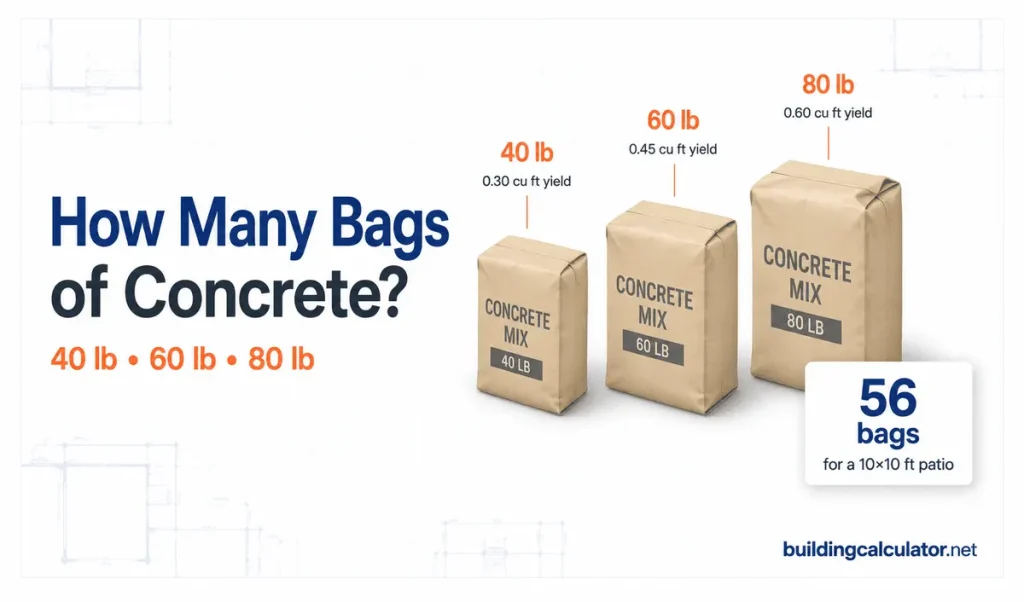
If you go the bag route, the number of bags you need depends on the bag size you buy (40, 60, or 80 lb), since each yields a different volume. For exact bag counts by project type, a full bag size comparison, and the bag count formula, see our complete guide on how many bags of concrete you need.
Why a 10% waste factor matters
Concrete waste isn’t carelessness. It’s physics. Even a perfectly measured slab loses material to:
- Subgrade unevenness: a 4-inch slab averaging 4.5 inches because of a slightly low spot uses 12% more concrete than calculated
- Spillage and overflow: some material always escapes when placing
- Edge over-pour: form boards aren’t always perfectly square; corners absorb extra
- Wheelbarrow and mixer residue: a few cubic feet stays stuck on every pour
Industry standard for residential pours is 10%. For DIY pours or irregular shapes, bump it to 15%. Tightly controlled commercial pours with experienced crews can go as low as 5%.
The 4 estimating mistakes that cost the most
1. Skipping the waste factor
The single most common mistake. People calculate exact volume, order that exact amount, and run short during the pour. Always include 10% minimum.
2. Using inches instead of feet (or vice versa) without converting
Multiplying length in feet by thickness in inches gives a number that looks reasonable but is wildly wrong. Always convert all dimensions to the same unit before multiplying.
3. Forgetting to multiply by quantity for multiple slabs
Pouring three identical 4 ft × 4 ft pads? You need 3x the volume of one. Sounds obvious, but it’s the single most common reason pours run short on multi-pad projects.
4. Trusting a contractor’s eyeball estimate
Rule of thumb estimates (“about 2 yards”) are usually within 30% of the right answer. That’s not close enough. Run the numbers using actual dimensions before ordering.
Get your exact concrete estimate
Tables and formulas get you in the ballpark, but for an exact number, plug your real dimensions into our free concrete slab calculator. It handles unit conversions automatically, lets you set a custom waste factor, and shows estimated cost if you enter your price.
The calculator works for slabs, patios, garage floors, shed pads, AC unit pads, hot tub pads, and any other rectangular concrete pour. Try the concrete slab calculator for your project.
Frequently asked questions
How much concrete do I need for a 10×10 slab?
A 10 ft × 10 ft slab at 4 inches thick requires 1.23 cubic yards (about 1.36 yards with 10% waste). At 6 inches thick, the same slab needs 1.85 cubic yards.
How much concrete do I need for a 12×12 slab?
A 12 ft × 12 ft slab at 4 inches thick requires 1.78 cubic yards (about 1.96 yards with 10% waste). At 6 inches thick, the same slab needs 2.67 cubic yards. A 12×12 pour sits right at the point where ready-mix delivery usually beats bags on cost.
How much concrete do I need for a fence post?
A standard 4-inch post in a 10-inch diameter hole, 24 inches deep, needs about 0.5 cubic feet of concrete per post. For how many bags that works out to across a full fence, see our how many bags of concrete guide.
Is it cheaper to buy bags or ready-mix?
For pours under 1 cubic yard, bags are usually cheaper. Above 1 yard, ready-mix delivery wins, even with the delivery fee. A 2-yard mini-mix delivery typically runs $300-$450 in most US markets.
How thick should my concrete slab be?
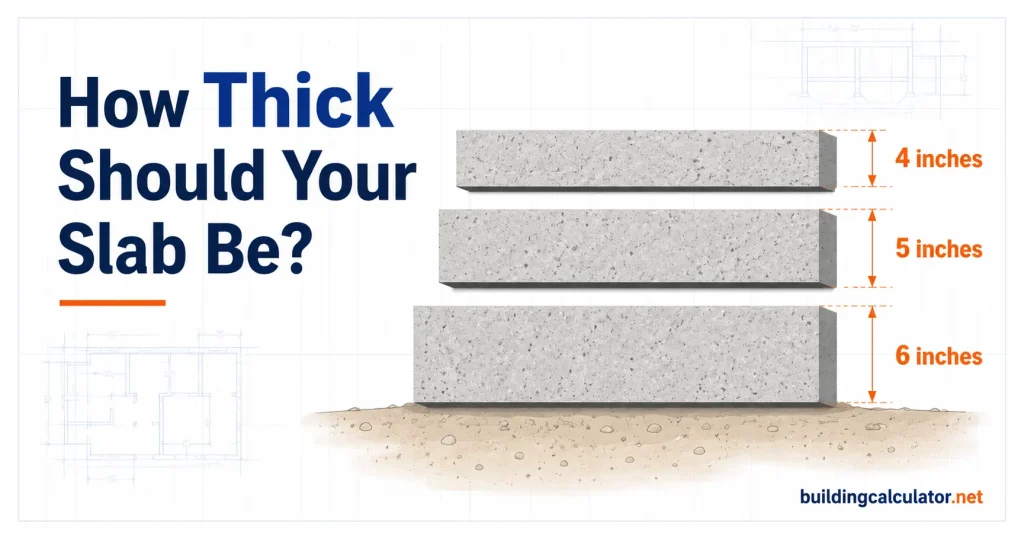
4 inches is standard for patios, walkways, and interior floors. 5 inches for slabs supporting walls. 6 inches for driveways and garages with vehicle traffic. 8 inches and above for heavy equipment pads.
Can I use this calculator for non-rectangular slabs?
The calculator handles rectangles, which covers most residential slabs. For circles, L-shapes, or T-shapes, divide the area into rectangles, calculate each separately, and add them together. Dedicated calculators for circular slabs and footings are coming soon.