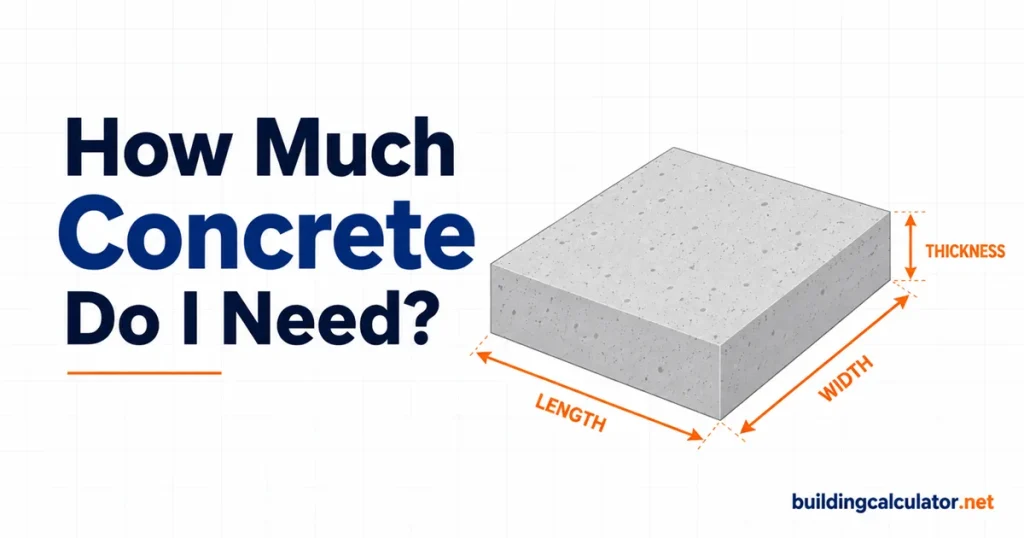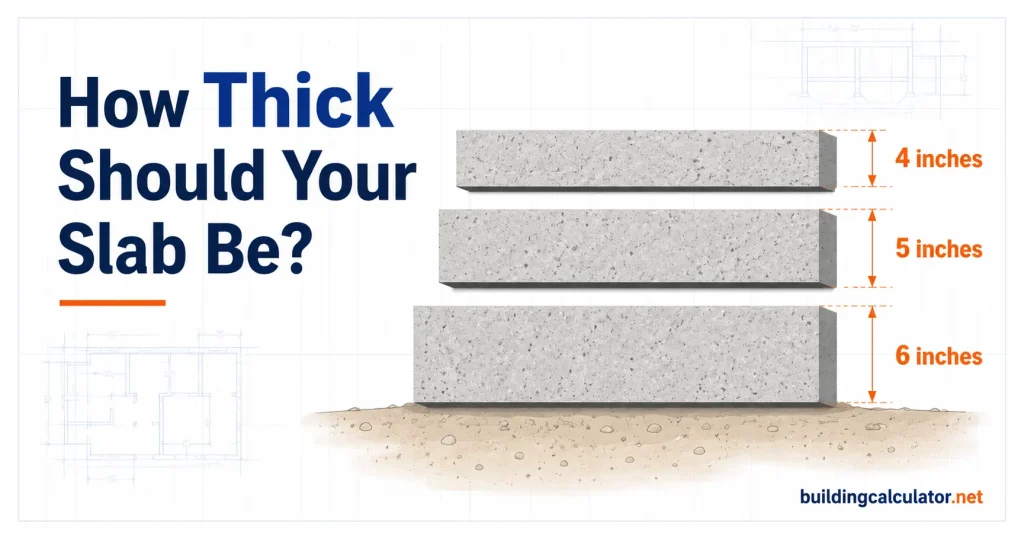
You are standing in the home improvement aisle staring at a stack of 60 pound concrete bags. The project is a 10 by 10 foot patio at 4 inches thick. How many bags do you actually need? Off by one bag and you make an extra trip. Off by ten and you waste $50 on returns. This guide gives you the exact bag counts for the most common DIY concrete projects, plus the math to handle anything else.
The answer depends on two things: the volume of concrete your project needs in cubic feet, and the bag size you choose at the store. Below you will find a quick answer table, project-by-project counts for slabs, footings, and post holes, plus the decision framework for when bags stop making sense and you should call a ready-mix truck instead.
Quick answer: bag counts for common projects
For most residential projects, here is what you actually need. These are raw bag counts based on project volume. Add 10 percent for waste before ordering, the standard allowance for residential pours.
| Project | 40 lb bags | 60 lb bags | 80 lb bags |
|---|---|---|---|
| 4 inch slab, 10 by 10 ft (33 cu ft) | 110 | 74 | 56 |
| 4 inch slab, 8 by 8 ft (21 cu ft) | 71 | 47 | 36 |
| 4 inch slab, 4 by 4 ft (5.3 cu ft) | 18 | 12 | 9 |
| 3 ft deep fence post hole (10 inch diameter) | 6 | 4 | 3 |
| 4 ft deep fence post hole (12 inch diameter) | 11 | 7 | 6 |
| Deck footing, 12 inch diameter, 4 ft deep | 11 | 7 | 6 |
| Mailbox post, 18 inch deep, 8 inch diameter | 2 | 2 | 1 |
If your project is not on this list, the math is straightforward. Calculate the volume in cubic feet, divide by the bag yield, and round up. The next section explains exactly how.
Understanding bag sizes and yields
Concrete bags come in three standard sizes in the US. Each bag yields a known volume when mixed with water at the manufacturer recommended ratio. These yields are what you divide your project volume by.
| Bag size | Yield (cu ft) | Yield (cu yd) | Bags per cu yd |
|---|---|---|---|
| 40 lb | 0.30 | 0.011 | 90 |
| 60 lb | 0.45 | 0.017 | 60 |
| 80 lb | 0.60 | 0.022 | 45 |
Yields vary slightly between manufacturers. Quikrete, Sakrete, and other major brands fall within a few percent of these figures. The 80 lb bag is the most economical per cubic foot, but it weighs as much as a small bag of cement and is harder to carry. The 40 lb bag is easier to handle but costs about 30 percent more per cubic foot of finished concrete.
The basic formula:
Bags needed = Project volume (cu ft) / Bag yield (cu ft per bag)
Always round up to the next whole bag, since you cannot buy a partial bag and partial mixes lose strength quickly. Add 10 percent for waste before rounding, or 15 percent for projects with complex geometry where waste is likely.
How to calculate concrete volume
Before counting bags, you need the project volume in cubic feet. The formula depends on the shape.
Rectangular slab
Volume (cu ft) = Length (ft) × Width (ft) × Thickness (ft)
Remember to convert thickness from inches to feet by dividing by 12. A 4 inch thick slab uses 4 / 12 = 0.333 feet in the formula.
Example: 10 ft × 10 ft × (4 / 12) = 33.3 cu ft
For an accurate slab estimate including reinforcement options, square footage breakdown, and ready-mix conversion, use our concrete slab calculator.
Cylindrical hole (post, footing, sonotube)
Volume (cu ft) = π × (Diameter / 2)² × Depth (all in feet)
Example: A 12 inch diameter footing dug 4 feet deep:
Diameter = 12 in = 1 ft, so radius = 0.5 ft
Volume = π × (0.5)² × 4 = 3.14 cu ft
Subtract the post volume if a wood or metal post will occupy part of the hole. A 4×4 post (actual 3.5 by 3.5 in) extending 4 ft into the hole displaces about 0.34 cu ft.
Stairs and steps
Stairs are easiest to calculate by treating each step as a rectangular block and summing the volumes. A 36 inch wide step that is 12 inches deep and 7 inches tall has a volume of 3 × 1 × (7 / 12) = 1.75 cu ft.
Project examples with full math
Example 1: A 10 by 10 ft patio at 4 inches thick
Volume: 10 × 10 × (4 / 12) = 33.33 cu ft
Bag counts:
- 40 lb bags: 33.33 / 0.30 = 111.1, round up to 112 bags (with 10% waste: 123)
- 60 lb bags: 33.33 / 0.45 = 74.1, round up to 75 bags (with 10% waste: 82)
- 80 lb bags: 33.33 / 0.60 = 55.6, round up to 56 bags (with 10% waste: 62)
At typical 2026 retail pricing of $5.50 per 80 lb bag, the material cost is approximately $310 to $325 for the patio. At this volume you are right at the threshold where ready-mix becomes more economical. See the decision section below.
Example 2: Six fence post holes, 10 inch diameter, 3 ft deep
Volume per hole: π × (5/12)² × 3 = 1.64 cu ft
Total for 6 holes: 9.82 cu ft
Subtract the post volume. A 4×4 post extending 3 ft into the hole displaces 0.26 cu ft, so for 6 posts you subtract 1.55 cu ft. Net concrete volume = 8.27 cu ft.
Bag counts:
- 60 lb bags: 8.27 / 0.45 = 18.4, round up to 19 bags
- 80 lb bags: 8.27 / 0.60 = 13.8, round up to 14 bags
For fence posts, fast-setting concrete (Quikrete Fast-Setting or similar) is often used. Fast-set mixes have the same yield per pound but cure to load-bearing strength in 20 to 40 minutes, letting you set and plumb posts the same day.
Example 3: Deck footings, four piers at 12 inch diameter, 4 ft deep
Volume per pier: π × (0.5)² × 4 = 3.14 cu ft
Total for 4 piers: 12.57 cu ft
Bag counts:
- 60 lb bags: 12.57 / 0.45 = 27.9, round up to 28 bags
- 80 lb bags: 12.57 / 0.60 = 20.9, round up to 21 bags
For deck footings, building codes typically require concrete that reaches at least 3,000 psi after 28 days. Standard concrete bag mix achieves this. Avoid using fast-setting concrete for structural footings unless the product label specifically states it meets structural strength requirements.
When to switch from bags to ready-mix
Bag mixing makes sense for small projects, but there is a point where the labor and time cost makes ready-mix cheaper and easier. The crossover is typically around 1 cubic yard of concrete, which is 27 cubic feet.
| Project volume | Recommended approach |
|---|---|
| Under 0.5 cu yd (under 14 cu ft) | Bag mix is straightforward, mix in a wheelbarrow or mixer |
| 0.5 to 1 cu yd (14 to 27 cu ft) | Bag mix is doable but tiring, rent a small mixer or split delivery |
| 1 to 2 cu yd (27 to 54 cu ft) | Threshold zone, compare costs of bags vs short-load ready-mix |
| Over 2 cu yd (over 54 cu ft) | Ready-mix is almost always more economical and produces better quality |
The crossover happens around 45 bags of 80 lb concrete (which equals about 1 cubic yard). At that volume you are mixing for 4 to 6 hours minimum, the cost of bags exceeds the cost of a short-load ready-mix delivery in most US markets, and the cold joints between batches can create weak spots in slabs.
Ready-mix has minimum delivery quantities (typically 1 to 3 cubic yards) and short-load fees if you order less than the truck minimum. For projects under 2 cubic yards, get a quote from a local supplier and compare it directly to the bag total. For projects of 3 cubic yards or more, ready-mix wins on cost almost universally.
If you are unsure whether your project crosses the threshold, our how much concrete do I need guide walks through volume calculations for slabs, footings, and posts, with the equivalent cubic yards for each.
Buying tips and storage
Buy concrete bags from a single supplier and a single production batch if possible. Different manufacturers can have slightly different colors when cured, which shows on visible slab surfaces. Most home centers source from one or two regional producers, so a single store run usually delivers a consistent batch.
Storage matters. Concrete bag mix absorbs moisture from the air and from contact with concrete floors. Bags lose strength over time, especially in humid conditions. If you cannot use bags within 2 to 3 weeks of purchase, store them off the floor on pallets, covered with plastic sheeting, in a dry location. Discard any bags that feel hard, lumpy, or partially set.
Always have one or two extra bags on hand beyond your calculated count. Running short mid-pour is much worse than buying an extra bag you can return. Most stores accept returns of unopened bags within 30 days with the receipt.
Ready to calculate your project?
For accurate concrete volumes including ready-mix conversions, slab thickness recommendations, and full cost estimates, try our free concrete slab calculator. Enter your project dimensions and the tool returns volume in cubic feet, cubic yards, and bag counts for all three standard bag sizes, plus an estimated material cost.
Frequently asked questions
How many 80 lb bags of concrete are in a cubic yard?
Approximately 45 bags. Each 80 lb bag yields 0.022 cubic yards, so 1 / 0.022 = 45.45, rounded up. At this volume, ready-mix delivery is typically more economical than bag mix.
How many bags of concrete for a 10×10 patio at 4 inches thick?
For a 10 by 10 ft patio at 4 inches thick (33 cu ft volume), you need approximately 112 bags of 40 lb, 75 bags of 60 lb, or 56 bags of 80 lb concrete as raw counts. Add 10 percent for waste before ordering. At this size, compare bag cost to a short-load ready-mix quote.
How many bags for a fence post?
For a standard fence post hole (10 inch diameter, 3 feet deep), you need 4 bags of 60 lb or 3 bags of 80 lb concrete. For a sturdier 4 ft deep, 12 inch diameter hole common in commercial fencing, plan on 7 bags of 60 lb or 6 bags of 80 lb. Fast-setting concrete is commonly used for fence posts to allow same-day plumbing.
What is the difference between concrete and cement?
Concrete is the finished construction material made of cement, sand, gravel, and water. Cement is just one ingredient. When you buy a bag labeled “concrete mix” at the home center, you are buying pre-blended dry ingredients (cement, sand, aggregate) that you mix with water. Bags labeled “cement” or “Portland cement” contain only the binder and require you to add sand and gravel separately.
Can I mix concrete by hand or do I need a mixer?
For projects under 5 bags, mixing in a wheelbarrow with a hoe or shovel is practical. For 5 to 20 bags, rent or buy a small electric or gas mixer. Above 20 bags, a mixer is essential, and above 45 bags (about 1 cubic yard), ready-mix delivery becomes more economical when you factor in mixer rental and labor time.
How long does concrete take to set?
Standard concrete reaches initial set in 4 to 8 hours, walking strength in 24 to 48 hours, and full design strength of 3,000 to 4,000 psi in 28 days. Fast-setting concrete reaches initial set in 20 to 40 minutes and walking strength in 1 to 4 hours, but final cured strength is slightly lower than standard concrete.
Should I add water inside or outside the bag?
Always mix in a wheelbarrow, mixer, or pan rather than the bag itself. Empty the dry mix into your mixing container, add water gradually while stirring, and stop when the mix reaches a consistency similar to thick oatmeal. Excess water permanently reduces concrete strength, so add water slowly and stop early.
Do bag counts include waste?
The bag counts in the tables and project examples are raw counts based on volume. Add 10 percent for waste before ordering, the standard allowance for residential pours, which covers spillage, partial bags, and over-pour. For complex projects (irregular shapes, multiple small pours, working in cold weather), use 15 percent. Always round up to the next whole bag, and keep one or two extra on hand so you never run short mid-pour.