Linear feet and square feet sound interchangeable and are anything but. One measures length, the other measures area, and materials at the store are priced in whichever unit fits how they are made. Mix them up and you either buy a quarter of the trim you need or four times the flooring.
This guide pins down what each unit actually measures, which materials use which, and the one piece of math that converts between them. By the end, a quote in either unit will read the same to you.
The short answer
A linear foot is 12 inches measured in a straight line: length only, one dimension. A square foot is an area of 12 by 12 inches: length times width, two dimensions. A 10 foot board is 10 linear feet no matter how wide it is; a 10 by 12 foot room is 120 square feet no matter what shape the boards covering it come in.
| Unit | Measures | Formula | Typical materials |
|---|---|---|---|
| Linear foot | Length (1D) | Just the length | Trim, lumber, fencing, pipe, countertop edging |
| Square foot | Area (2D) | Length × Width | Flooring, drywall, paint, tile, roofing, sod |
The pattern behind the table: materials installed along a line are sold by the linear foot, and materials that cover a surface are sold by the square foot.
What is a linear foot?
A linear foot is simply length, measured in a straight line, ignoring width and thickness entirely. A 1×4 board 8 feet long and a 2×12 board 8 feet long are both 8 linear feet, even though one contains far more wood. That is exactly why linear pricing only appears where the width is fixed by the product: a specific baseboard profile, a particular fence style, a given pipe diameter. You are paying for length because length is the only thing that varies.
Measuring linear feet is addition, not multiplication. Baseboard for a room is the perimeter of the room minus the doorways. A fence is the total run along the property line. If a wall has three sections of 10, 8, and 12 feet, the trim need is 30 linear feet.
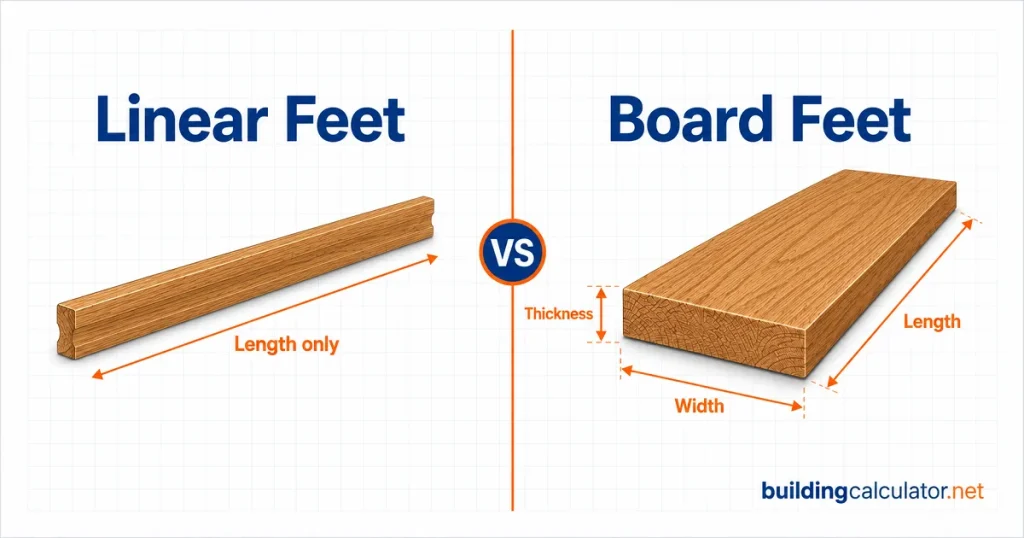
One caution from the lumber aisle: a linear foot is not a board foot. A board foot is a volume unit that does account for width and thickness, which is why two 8 foot boards of different sizes cost different amounts even when priced “per board foot.” Our linear feet vs board feet guide covers that distinction, and our board foot calculator does the lumber math.
What is a square foot?
A square foot is area: the space inside a 12 by 12 inch square. It takes two measurements to compute, length times width, both in feet. A 12 by 15 foot room is 180 square feet, and so is a 9 by 20 foot room, which is the point: square footage describes how much surface there is, not what shape it takes.
Surface-covering materials are priced this way because coverage is what you are buying. Flooring, drywall, paint, tile, roofing shingles, and sod all quote per square foot (roofing then groups 100 square feet into a “square”). To estimate any of them, measure the surface’s two dimensions, multiply, and add a waste factor. For floors specifically, our flooring calculator turns a room size into square feet, boxes, and cost in one pass.
Converting between linear feet and square feet
Here is the part that trips people up: there is no fixed conversion. The two units measure different things, and the bridge between them is the width of the material. The math is one formula in two directions:
Square feet = Linear feet × Width in feet
Linear feet = Square feet ÷ Width in feet
Convert the width to feet first when it is given in inches (divide by 12). A 5 inch wide plank is 5/12 = 0.417 feet wide, so 100 linear feet of it covers 100 × 0.417 = 41.7 square feet. Run the other way: a 180 square foot room needs 180 ÷ 0.417 = about 432 linear feet of that plank.
Because the width drives everything, the same area translates to very different lengths depending on the material:
| Material width | Width in feet | Linear feet per 100 sq ft |
|---|---|---|
| 2 1/4 in (strip hardwood) | 0.188 | 533 |
| 3 in | 0.250 | 400 |
| 5 in (wide plank) | 0.417 | 240 |
| 7 1/2 in (LVP) | 0.625 | 160 |
| 12 in | 1.000 | 100 |
The classic real-world case is roll carpet. A standard roll is 12 feet wide, so one linear foot of roll is 12 square feet of carpet. A salesperson quoting “15 linear feet” of a 12 foot roll is offering 180 square feet, the same quantity a flooring store would quote as 20 square yards (a square yard is 9 square feet, the carpet trade’s traditional unit).
Worked example: one room, both units
A 12 by 15 foot bedroom is getting new flooring and new baseboard, and the two materials use the two different units.
Flooring (square feet):
Area = 12 × 15 = 180 square feet
With a 10 percent waste allowance: 180 × 1.10 = 198 square feet to buy
Baseboard (linear feet):
Perimeter = 2 × (12 + 15) = 54 linear feet
Subtract one 3 foot doorway: 54 – 3 = 51 linear feet to buy
Same room, two completely different numbers, because the flooring covers the surface while the baseboard runs along a line. Price each in its own unit: 198 square feet times the flooring’s per-square-foot price, 51 linear feet times the baseboard’s per-linear-foot price. Run the flooring half through our flooring calculator to get the box count as well.
Which unit does your material use?
Sold by the linear foot: baseboard, crown molding, and all trim; dimensional lumber off the rack; fencing; gutters; countertop edging; pipe and conduit; deck railing. The width is fixed by the product, so length is the price driver.
Sold by the square foot: flooring of every kind, drywall, paint coverage, tile, roofing, wallpaper, sod, and countertop surfaces. These cover area, so area is the price driver.
Sold by something else entirely: rough lumber by the board foot (a volume unit), concrete by the cubic yard, gravel by the ton. When a quote’s unit surprises you, it is usually because the material is priced by volume or weight rather than length or area.
Frequently asked questions
How many linear feet are in a square foot?
There is no fixed answer, because the units measure different things. The conversion depends on the material’s width: linear feet = square feet ÷ width in feet. For a 6 inch wide board (0.5 feet), one square foot is 2 linear feet; for a 3 inch board, it is 4 linear feet.
How do I convert square feet to linear feet for flooring?
Divide the square footage by the plank width in feet. A 180 square foot room in 5 inch planks (5 ÷ 12 = 0.417 feet) needs 180 ÷ 0.417, about 432 linear feet of plank. In practice you rarely need this number, because flooring is sold by the square foot and by the box; it mainly matters when comparing a per-linear-foot quote to a per-square-foot one.
How many linear feet of baseboard do I need?
Measure the room’s perimeter (add up all wall lengths) and subtract the doorways and openings. A 12 by 15 foot room has a 54 foot perimeter; with one 3 foot doorway, that is 51 linear feet of baseboard. Add about 10 percent for miter cuts and mistakes, since corner cuts consume extra length.
Is carpet sold in square feet or square yards?
Both, depending on the seller. The carpet trade traditionally prices per square yard (9 square feet), while home centers increasingly quote per square foot. Roll carpet also appears as linear feet of a 12 foot wide roll, where each linear foot equals 12 square feet. Convert everything to one unit before comparing prices.
Is a linear foot the same as a board foot?
No. A linear foot is pure length, while a board foot is volume: 144 cubic inches of wood, accounting for thickness and width as well as length. An 8 foot 1×6 is 8 linear feet but only 4 board feet. The distinction matters whenever lumber is priced per board foot; our linear feet vs board feet guide breaks it down with examples.
Why is trim sold by the linear foot but flooring by the square foot?
Because of what varies. A trim profile has a fixed width, so the only quantity you choose is length, and pricing follows it. Flooring covers a two-dimensional surface, so the quantity you need is area. Each material is priced in the unit that matches how it is consumed.
How do I measure linear feet for a fence?
Measure the total run along the ground where the fence will stand, adding each straight section: a yard with 60, 40, and 60 foot sides to enclose needs 160 linear feet of fence. Gates are usually priced separately, so subtract their widths from the fence run and add them as line items.